Author: Linde

  • CRAZY FISH SING

    12 / 06 / 24 CRAZY FISH SING / STILL HERE

    On 12 June 2024, Suranga Katugampala, Peter Bruno, Simone Brioni discussed with me their collective book Crazy Fish Sing. A Soud Rature of ‘Still Here’, which was inspired by their co-production for their upcoming film, Still Here. Next to screenings of excerpts of the upcoming film, we discussed the making process and contents of the visual art book, which includes stills, drawings, and poetic and philosophical reflections on filmmaking in general and producing this film in particular, and travels through media, geographical spaces, and languages. It includes (amoung others) cinematographic, psychoanalytic, scholarly, architectural, and design perspectives, and is an experience in itself. The reader gets immersed in stream-of-consciousnesses, and is referred from pop music, to comic books, to more abstract theory.

    This event was part of the ARTES Film Lab series entitled Edit, (Re-) visit. Film in Research / Research in Film, during which meetings we discuss filmmaking processes, research endeavours, and anything and everything that entangles the two. Indeed, the discussions of the Film Lab circle around ‘the intricate relationship between the practices related to cinematographic productions, the practices of academic work, and theory and reflection (Brioni, Polezzi, Sinopoli, 2023).’

    This production is an example of where current academic work is steering towards: it is multi-, inter-, and transdisciplinary, in that it combines disciplinary perspectives, intermingles them, and goes beyond the academic perspective through interaction between artists, academics, and practicioners of various fields.

    Description: Crazy Fish Sing (Yogurt Editions 2024) is a visual art book inspired by Suranga Katugampala’s forthcoming film, Still Here. Situated in an experimental territory on the border between noir and documentary, the film is shot in Colombo, Sri Lanka, and Milan, Italy. Transporting the reader through its real, imagined, and affective geographies, Crazy Fish Sing offers a unique behind-the-scenes perspective on the making of Still Here and the questions this film raises about cultural hybridity, urbanization, and realism.

    For more information about the book, you can follow this link, and see the video below.

    ______

  • ARTES Film Lab: Upcoming Event, 9 October 2024

    All are welcome to come to the second Edit, (Re-) Visit. Film in Research / Research in Film event organised at the University of Amsterdam on 9 October, 16.00-18.00 in Bushuis/Oostindisch Huis, Eo.14C.
    Dr. Louie Dean Valencia will give a lecture entitled Trans-forming Fascist Film: Imagination and Historical Reality in Franco’s Spain (and I will be discussing this topic with him afterwards).

    The event can also be found on the ARTES event webpage.

  • Film en discussie: La Chimera

    Op 22 mei 2024 zal ik deel uitmaken van een panel na afloop van een filmvertoning van La chimera in Het Ketelhuis. Voor meer informatie, klik hier.

    Trailer van de film:

  • Boekenrecensie

    Er staat een stukje van mij in de Nederlandse Boekengids; lees hier meer (en neem een abonnement!)

  • This Wednesday: Introduction to La grande bouffe (Marco Ferreri) at Cineforum in Kriterion, Amsterdam

    On Wednesday, 22 September 2021, at 19.30, I will introduce the Cineforum: European Cinema: The Failed Canon, which will take place in Cinema Kriterion in Amsterdam. Do you think ‘European cinema’ as an entity exists? We invite you to contemplate or contribute your perspectives on the (im)possibility of a European film canon. The cineforum will continue for two days on the 23rd and 24th of September, during which ten screenings will open the discussion to various themes concerning European culture.

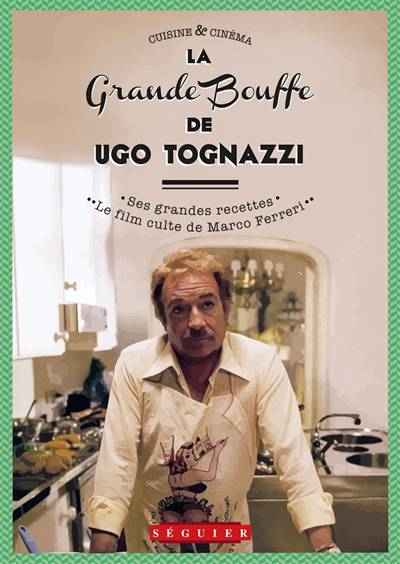
    The opening film will be La grande bouffe (Marco Ferreri, 1973). Booed in Cannes, censored in cinemas at the time, this film has by now become a cult classic of European cinema history. Central themes – haute cuisine, decadence, existentialism, and the grotesque – are strongly related to European traditions and history, while the plot of the film alludes to a European culture in decay. The focus is on a group of friends who decide to eat themselves to death. They do so in style, one of them being a great cook and preparing the most exquisite meals. While this setup might suggest an atmosphere of vulgarity, the film is in fact not (merely) that, but comical, heartfelt, and human.

    La grande bouffe continues to inspire theatre productions (Toneelgroep Amsterdam, 2010), art exhibitions (Soissons, France, 2017), and, obviously, cookbooks (Ugo Tognazzi, 2017; see below). Marco Ferreri (1928-1997), the anarchist filmmaker par excellence, explained that ‘Without my cinema, there is nothing. I think through my films’. While indeed there is a strong philosophical debate at the heart of this exciting picture, we could just as well argue that Ferreri feels through his films.

  • Conference paper / Intervento convegno

    Last week, I participated at the conference Postcolonial Italian cinema.

    La settimana scorsa, ho partecipato al convegno Postcolonial Italian cinema.

    Following this link (of LABS, Audiovisual Laboratory for Performances Sapienza) videos of all papers can be found.

    Seguendo questo link (di LABS, Laboratorio Audiovisivo per lo Spettacolo Sapienza) si possono trovare video di tutti gli interventi.

    In my paper, I discussed my PhD dissertation. Combining Italian Studies with Postcolonial Theory and Film Studies, it explores representations of what I have coined the Black Other, but it is actually about italianità: In order to construct the cinematographic figure of the ‘italiano medio’ this Black Other (everything the italiano medio is not [or not supposed to be]) resulted to be a much required and central figure in four commedie all’italiana that formed the corpus of the research. What I argued is that this cinematographic Black Other gains in agency over this period of two decades, as this character both comes to dominate iconic ‘Italian’ public spaces inside film plots, and from a meta-perspective, taking over a dominant position in some of the most critically acclaimed cinematographic productions now belonging to what we could describe as the ‘Italian cultural archive’. As such, imaginaries of an ‘Italian identity’, which strongly interrelated with colonial enterprises, are deconstructed, predicting current socio-political crises many European nation states find themselves in.

    Durante mio intervento ho parlato del mio progetto di dottorato. Legando Italian Studies con studi postcoloniali e studi del cinema, esplora rappresentazioni di quello che ho sopranominato ‘l’Altro nero’ – mentre in realtà si tratta dell’italianità – : il cosidetto ‘Altro nero’ (il che, semplificando, è tutto ciò che ‘l’italiano medio’ non doveva o non poteva essere) risultava una figura centrale e fondamentale per la costruzione della figura cinematografica ‘l’italiano medio’ in quattro commedie all’italiana che formavano il corpus della mia ricerca. Ho cercato di mostrare che questo ‘Altro nero’ cinematografico in ogni film si dimostra più libero di esprimere e vivere la propria soggettività, considerando che esso 1) occupa sempre più spazi pubblici ‘tipici italiano’ dentro le trame dei film e 2) da una prospettiva ‘meta’ prende una posizione sempre più dominante in alcune delle produzioni cinematografiche più celebre che oggi fanno parte di quello che si potrebbe chiamare ‘l’archivio culturale italiano’. Perciò, in questi film, immaginari di una ‘identità italiana’, fortemente intrecciata con le imprese coloniali, vengono decostruite, prevedendo le crisi socio-politici di tanti paesi nell’Europa di oggi.

    The four films are / I quattro film sono:

    Lo sceicco bianco (Federico Fellini, 1952)

    Il moralista (Giorgio Bianchi, 1959)

    Oggi, domani, dopodomani (Marco Ferreri, Luciano Salce, Eduardo De Filippo, 1965)

    Riusciranno i nostri eroi a ritrovare l’amico misteriosamente scomparso in Africa? (Ettore Scola, 1968)

  • Migrazioni al plurale

    Insieme a Monica Jansen, Manuela Pinto e Carlo Giordano ho partecipato al progetto ‘Migrazioni al plurale’, per il quale studenti del secondo anno di italianistica all’Università di Utrecht (UU) hanno fatto video-interviste a signori italiani che vivono (da molto tempo) in Olanda e che sono membri dell’Acli. Durante le interviste gli studenti hanno fatto domande su vari temi, come il trasloco, le differenze tra l’Olanda e l’Italia, e questioni linguistiche.

    È stato un bellissimo incontro e mi ha fatto molto piacere essere coinvolta. Complimenti a tutt*!

    Seguendo questo link si possono trovare più informazioni su un progetto che speriamo di continuare nel prossimo anno accademico all’UU, e qui invece si trovano i video fatti dagli studenti.

    Li inserisco anche qui sotto.

  • Conference paper (video included)

    Lat week, I had the pleasure to speak at a wonderful conference organised by DAMS Roma Tre: XXVI Convegno Internazionale di Studi Cinematografici. DAMS Roma Tre has a Facebook page onto which the entire conference was published. I spoke on my research on somalo-italianità, which you can find in the link below. (I am the third speaker).
    https://fb.watch/5q6TuE3jv1/

  • Presentation

    On 26 January 2021, I will present my findings of a research project which will be accompanied by a film, Signs of Somalo-Italianità.

    Here, you can find out how to apply:

    https://www.uu.nl/en/events/somalo-italianita-and-its-discontinuities-in-northern-europe.

    Below, some more information.

    VIDEO-PRESENTATION LINDE LUIJNENBURG
    UNIVERSITY OF AMSTERDAM
    SOMALO-ITALIANITÀ AND ITS DIS/CONTINUITIES IN NORTHERN EUROPE THE DISCOURSE OF ITALIANITÀ IN PARTICULAR SOMALI DIASPORIC COMMUNITIES IN THE UNITED KINGDOM AND THE NETHERLANDS
    Wanneer:
    26 januari, 11.00-12.00
    Waar:
    Meeting in de Teams “BA-Italiaanse taal en cultuur”, Universiteit Utrecht (via link die wordt toegestuurd na registratie) Registratie:
    Stuur een mail voor 25 januari aan:
    August Ammerlaan, A.N.A.Ammerlaan@uu.nl
    Voertaal: Engels
    Abstract This talk will address linguistic, sonic, visual, and material information communicating imaginaries of identities relating to italianità in Somali diasporic communities in England and the Netherlands. How do language and sonic, visual and material appearances related to particular languages incorporate, enable, or re-shape identity formations in our ‘super-diverse’ cities?
    What implications do other practices related to languages have, and how do they communicate identity formations within particular communities? Talking you through the project with cinematographic findings in the background, Luijnenburg will combine sociolinguistic and ethnographic analyses – such as Linguistic Landscape Studies and Translanguaging – with (Italian) postcolonial theory and the ‘unimedial language’ of the cinematic gaze. She will discuss in-depth interviews with Somali individuals now living in Birmingham, London, and Amsterdam who speak Italian, a video recording of these interviews and the (linguistic) landscapes of these individuals, and the Digital Humanities project in the shape of an online discussion of the film she produced together with them (still in process).
    Bio
    Dr. Linde Luijnenburg is lecturer in European Culture and Italian Studies at the University of Amsterdam. She conducted her PhD in Italian film studies at the University of Warwick (UK), where she explored representations of a ‘Black Other’ in the commedia all’italiana. She has published peer-reviewed articles on Dutch and Italian literature and film. Her research interests include Italian Studies, Film Studies, Somali Studies, Translanguaging, (Trans-)National Identities, Postcolonial Theory, Comparative Literature, and Narratology.
    She is also a filmmaker and intends to integrate the practical and theoretical implications of the Seventh Art into her academic research and teachings.
    Contact organisatoren:
    Manuela Pinto, m.pinto@uu.nl Monica Jansen, m.m.jansen@uu.nl
  • Translating the Neighbourhood

    On 2 and 3 November, the online multi-disciplinary event Translating the Neighbourhood discusses urban spaces, which ‘have always been places of translation, where encounters between languages and cultures have given birth to both conflict and exchange.’ Organised by Andrea Ciribuco, Anne O’Connor (NUI Galway), it brings scholars in translation studies (and outcasts like myself) together with artists and poets. Keynote speakers Prof. Loredana Polezzi (Stony Brook University) and Prof. Sherry Simon (Concordia University) discussed in an informal manner their latest findings in the field, and thus far, it has been nothing short of inspiring.

    More on the project: https://somaloitalianitainuk.wordpress.com/.

    I will be presenting my project on somalo-italianità in the UK and the Netherlands; The video of the paper can be found here.

    Painting presented at Golol Gallery, mentioned in the documentary part of this project.

    Below, the official description of the conference, and the conference scheme.

    “Urban spaces have always been places of translation, where encounters between languages and cultures have given birth to both conflict and exchange. In the last few decades, increasingly diverse urban environments have emerged, making coexistence between different communities a key contemporary issue. As a multi-disciplinary event, this conference explores urban spaces (cities and towns) as areas of translation, of dialogue and silence, communication and interaction.

    This conference deals with translation in society and beyond the text: translation as the managing of difference, a tool for inclusion or exclusion within the context of the contemporary urban space. As a multi-disciplinary, multi-media event, the conference intends to explore the different instances where people perform translation on the social stage in response to the many challenges and stimuli of 21st century globalization. Some of these translations are performed by professionals, some by non- professionals; some are intended to impact policy or contribute to a public debate, while others may last the short space of an oral exchange.”

    10:00-10.30  Opening Remarks
    10.30-12:00Panel 1: Bringing literary translation into the city  

    – Martina Ožbot (Univerza v Ljubljani, Slovenia): “The paradox of translation in multilingual and multicultural Trieste”
    – María Laura Escobar (independent scholar): “Hijacking slam poetry: enter the translator”
    – Jennifer Arnold (University College Cork, Ireland): “Reading Across cultures: The Role of Translated Literature in Multicultural and Multilingual communities”  
    12:00 -1.30Panel 2: Translation and the visual

    – Eliana Maestri (University of Exeter, UK): “Translating urban landscape into the visual”
    – Joanna Sobesto (Uniwersytet Jagielloński, Poland): “The art of giving the voice. Areas of translation in The Museum of Contemporary Art in Kraków.”
    – Luc van Doorslaer (Tartu Ülikool, Estonia) & Irmak Ugur (KU Leuven, Belgium): “The Multilayered Neighbor: Museum translation in a Turkish-Syrian border town”  
    1:30 – 3:00Lunch break Networking virtual rooms available for panelists  
    3:00 – 4:30Panel 3: Translation and community-building

    – Rachel E. Love (New York University, USA): “Singing the Roman Neighbourhood: The Multicultural Music and Political Protest of the Orchestra di Piazza Vittorio and Roma Forestiera Project”
    – Peter Flynn (KU Leuven, Belgium): “Translating in the Neighbourhood: the case of an Irish pub in Ghent”
    – Ann De Leon & Sathya Rao (University of Alberta, Canada): “A Tale of Two Cities: Comparing Translation Policies and Practices in Toronto and Edmonton”  
    4:30 – 6:30Keynote: “The place of translation in the neighbourhood: Loredana Polezzi and Sherry Simon in conversation” Followed by Q&A

    November 3

    (please note that all times are indicated at Irish time, UTC+0)

    9:30 – 11:00Panel 4: Translation from the ground up

    – Wine Tesseur (Dublin City University, Ireland): “Translation as empowerment: international NGOs as global and urban translating organisations”
    – Egshig Shagdarsuren (Монгол Улсын Их Сургууль, Mongolia): “Translation impact on native languages: the trade pidgin of Mongols”
    – María Aguilar Solano (Universitat Pompeu Fabra, Spain): “A popular education approach to interpreting training: building a community of interpreters from the ground up”  
    11:00 – 1:00Panel 5: Translation, migration, empowerment  

    – Paola Brusasco (Università degli studi “G. d’Annunzio” Chieti – Pescara, Italy): “Translation as a doorway to integration: the LAPISS project in Italy”
    – Karen Bennett (Universidade Nova de Lisboa, Portugal): “Social responsibility in the translation of the migration crisis”
    – Lorena Pérez Macías (Universidad Autónoma de Madrid, Spain) & Francisco Vigier-Moreno (Universidad Pablo de Olavide, Spain): “The use of postediting in context of asylum: a practical case study in collaboration with asylum organisations in Seville (Spain)”
    – Linde Luijnenburg (Universiteit van Amsterdam, Netherlands): “Signs of Somalo-Italianità: Italianità as a discourse in Somali diasporic communities in the U.K. and the N.L.”   
    1:00 -2:00Lunch break
    2:00 – 2:30Tangible translation: Migrants and refugees at the interface of translation and materiality: a call for papers (Q&A)
    3:00 – 4:00Artist workshop 1:
    Felispeaks: “The Corners of Our Image”

    This will be an interactive workshop with Spoken Word Performance artist, Felispeaks. This workshop will consist of translating our ideas and impressions of Black people and bodies in different settings and situations – using images and pictures as an aid. We will discuss using poetry and word games how we arrive at our conclusions by connecting our thoughts to the presented image; furthermore, Felispeaks will perform a poem to go with each image after each section of conversation.
    ‘The Corners of Our Image’ promises to give a range of perspective about what we know of an identity, what we have learned of said identity, how we arrive at our conclusions and finally the reality of that identity from one lens through poetry!
    4:30 -5:30Artist workshop 2:

    Brú Theatre  

    This artist led workshop will explore some of Brú Theatre’s Irish language work, looking at how they make it accessible to non Irish speaking audiences. There will be particular emphasis on two pieces; their most recent piece Ar Ais Arís in which Irish language literature meets visual poetry in Virtual Reality and Cleite, a site specific theatre piece merging Sean nós singing, Basel mask and west of Ireland superstitions. .
    The workshop will be given by James Riordan, Brú’s Artistic Director. Brú Theatre are based in Galway and make work in both Irish and English. They tour nationally and have multiple Irish Times Theatre Award nominations for their work. See more at http://www.brutheatre.com
    5:30 -6:00Concluding remarks – presentation of the new Emily Anderson Centre for Translation Research and Practice at NUI Galway (https://nuigalwaytranslation.wordpress.com/)